
Describing Ply: Why it's a Mess (and Why We Have Even More Labels)
Ply in backgammon is weird and so we've sidestepped the whole issue and invented our own naming system. Which will probably make everything even more confusing.
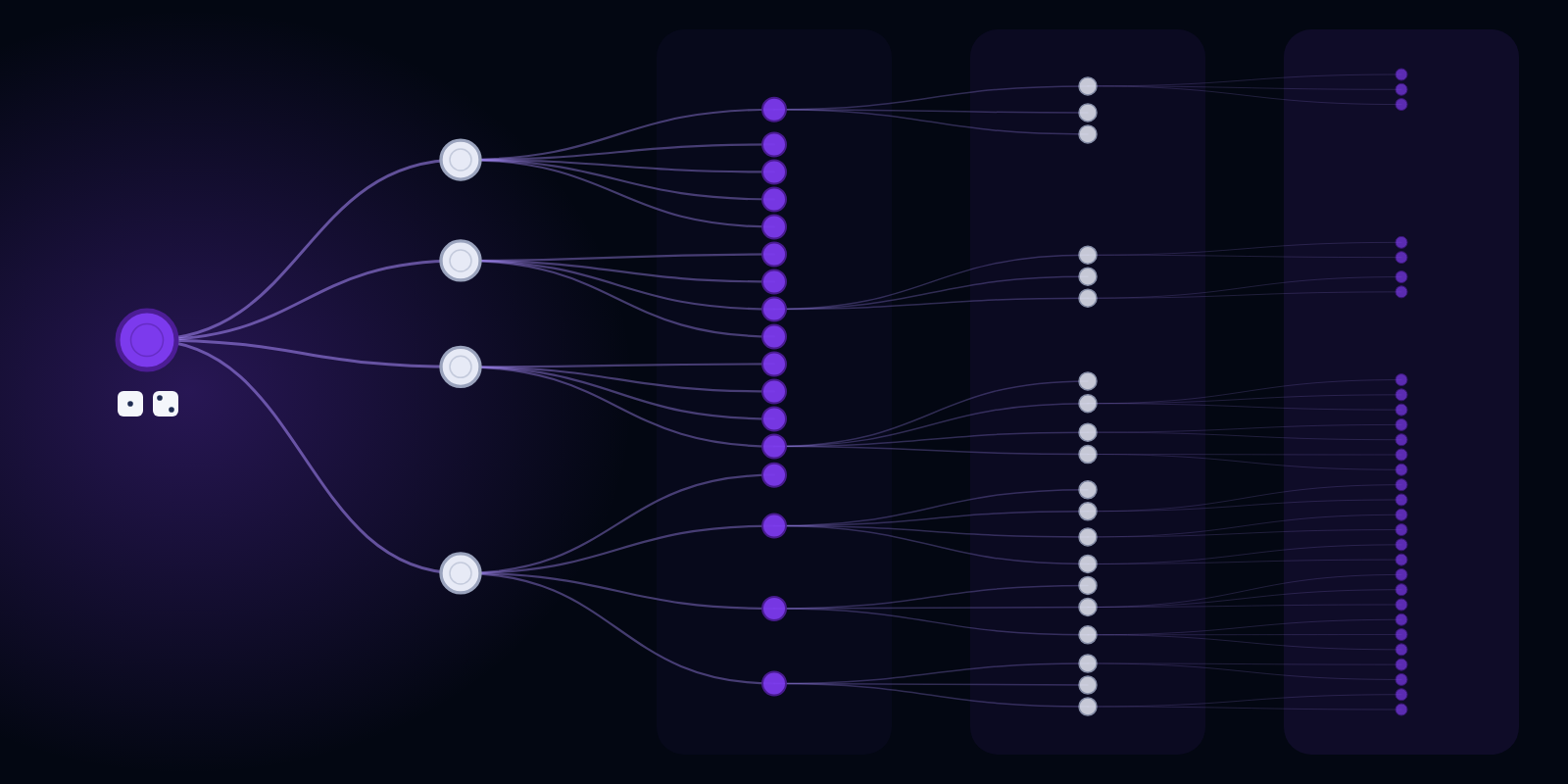
In games, words like "move" and "turn" are ambiguous, and their meaning differs by game and by tradition. Sometimes a move is one player's go; sometimes it means everyone at the table has one.
The term ply was coined to be unambiguous: it is one action by one player. In a two-player game a ply is a half-move, so 2 plies is one whole turn (white moves, then black moves), and 2-ply means an engine looks two half-moves forward in the game tree.
Forward from where, though, turns out to be a problem.
Most game engines, in chess and backgammon, consider 1-ply to be the shallowest search depth. Looking at all moves from the current position is the first ply; if you go to 2-ply, you're looking at all moves by your opponent after looking at all your possible moves.
This format is adopted by both Snowie and eXtremeGammon. The number describes the search from the position on the board, so your own move is the first ply.
Unfortunately, GNU Backgammon adopted different terminology. It calls that first search depth 0-ply. 1-ply looks at the 21 opponent rolls and their best replies on top of that, and so on. Your own move is never counted.
There's nothing inherently wrong about GNUBG's choice. Both are internally consistent, they just measure different things and they always differ by exactly one.
That creates an unfortunate situation where GNUBG looks like it has a worse search depth. GNUBG at 3-ply analysis is going to the same search depth as XG (or Snowie) 4-ply, but it feels worse. (Same depth, mind, not necessarily the same strength. The neural nets and move filters differ, so this is a like-for-like comparison of effort, not of accuracy.)
Backgammon Galaxy is perhaps the most used modern backgammon server today. It now runs its own enhanced build of GNU Backgammon, but it kept the XG-style ply numbers. Their own page says it plainly: free members get "Gnu 1-ply (called 2-ply on Galaxy)".
BackgammonDB has integrated GNUBG as its analysis engine, so I had to decide what to call the different depths. Doing GNUBG 2-ply and calling it 2-ply feels like underselling things. But then calling it 3-ply is arguably wrong (that's not what GNUBG calls it). So I'm sidestepping the issue entirely and inventing yet more non-numeric labels for analysis.
Introducing Quick, Smart and Deep, the three analysis tiers of BackgammonDB. These are the equivalent to XG's 2-ply, 3-ply and 4-ply. And they are, behind the scenes, what GNUBG calls 1-ply, 2-ply and 3-ply. Hover over any mention of these labels in the app and you'll see the real ply on both scales.
I realize I've just introduced yet more nomenclature. Other apps have labels too, and we considered using these: but GNUBG doesn't have anything for 1-ply, and names like Professional, World Class, Supremo and Grandmaster are meaningless on their own. Some are overloaded too: XG's performance-rating bands reuse Expert and World Class to describe how well you played a match, so "World Class" is a 2-ply bot in GNUBG and a PR between 2.5 and 5.0 in XG. Rather than a judgement call on what a backgammon "professional" is, we instead picked short, simple terms that describe the time and effort to analyze the position.
| What the engine looks at | GNU Backgammon | eXtreme Gammon | BackgammonDB |
|---|---|---|---|
| Your candidate move, then a static evaluation of the resulting position | 0-ply · Expert | 1-ply · Expert | (Not offered) |
| Plus every opponent reply | 1-ply · (no name) | 2-ply · Professional | Quick |
| Plus your reply to each of those | 2-ply · World Class | 3-ply · eXtremeGammon | Smart |
| Three replies deep | 3-ply · Grandmaster | 4-ply · (no name) | Deep |
| Four replies deep | 4-ply | (none) | (Not offered) |
| Truncated or full rollouts | Rollout | XG Roller, XG Roller+, XG Roller++, Rollout | (Not offered) |
Review your matches with BackgammonDB.
Import eXtreme Gammon and GNU Backgammon match files, find your blunders, and quiz yourself on the positions you got wrong. Free, no account required — your matches stay in your browser.